
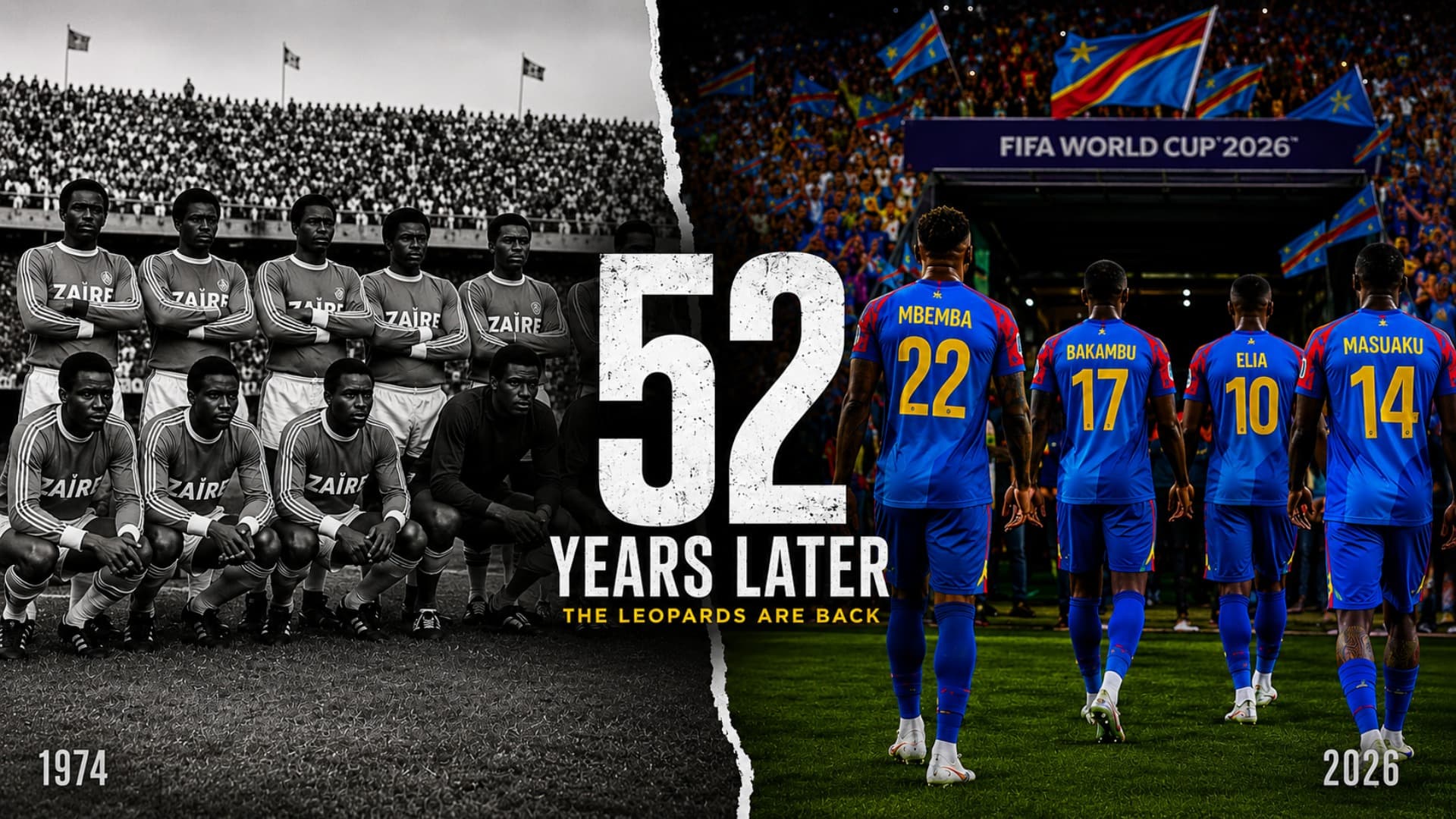
The Democratic Republic of Congo is heading back to the FIFA World Cup for the first time in 52 years — and for millions of Congolese people around the world, the moment means far more than football.
In April 2026, DR Congo officially secured qualification for the FIFA World Cup after a dramatic 1-0 extra-time victory over Jamaica in the intercontinental playoff, with defender Axel Tuanzebe scoring the historic winning goal.
For older generations, the qualification immediately brought back memories of 1974, when the country — then known as Zaire — became the first Sub-Saharan African nation ever to play in the World Cup. But this qualification feels different. It arrives at a time when the Congolese people, both at home and across the diaspora, are searching for moments of unity, pride, and global recognition after decades of hardship.
The Leopards are no longer simply participating. They are arriving with belief, talent, and momentum.
Led by head coach Sébastien Desabre and captain Chancel Mbemba, the squad features a growing collection of internationally recognized players, including Aaron Wan-Bissaka, Axel Tuanzebe, Cédric Bakambu, Arthur Masuaku, and Meschack Elia. The team has been drawn into Group K alongside Portugal, Colombia, and Uzbekistan, with their opening match scheduled for June 17 at NRG Stadium in Houston.
Houston itself is preparing to become a temporary home for the Congolese national team. DR Congo selected the city as its official World Cup base camp, with the team training at the renovated SaberCats Stadium facility throughout the tournament. For the large African and Congolese communities in Texas and across the United States, the World Cup will become a celebration of identity, culture, music, food, and resilience.
But even amid this historic celebration, the country is once again confronting another serious challenge.
A renewed Ebola outbreak in Central Africa has created growing international concern just weeks before the start of the tournament. The World Health Organization recently elevated the situation to a global health emergency as cases continue to spread in parts of the region.
The outbreak has already impacted DR Congo’s World Cup preparations. The team canceled a planned pre-tournament training camp in Kinshasa due to health concerns and international travel complications. U.S. authorities have also introduced heightened Ebola-related screening and travel measures for individuals arriving from affected countries.
Still, health officials continue to emphasize that the risk to the broader public remains low and that precautionary measures are designed to protect travelers while allowing international events to continue safely.
Unfortunately, Congo often faces a double burden during moments like these. Even when outbreaks are localized, the entire region can become associated with fear and stigma in the eyes of the world. The headlines frequently focus only on disease, war, and instability while ignoring the humanity and resilience of the Congolese people themselves.
That is why this World Cup matters so deeply.
This is not just a football story. It is a global reminder that Congo is more than its crises.
The Democratic Republic of Congo is one of Africa’s most culturally influential nations. It has shaped modern African music, produced world-class athletes and artists, and built one of the most vibrant diasporas anywhere in the world. Despite decades of conflict, displacement, political instability, and economic struggle, the Congolese people continue to create, innovate, and persevere.
For young Congolese children watching around the world, seeing their flag on the World Cup stage represents possibility. It tells them that their nation belongs among the world’s elite despite every obstacle placed in its path.
The international community should celebrate this moment with Congo — but also stand beside the country beyond the tournament itself.
Supporting Congo means investing in healthcare infrastructure, education, peacebuilding, economic development, and long-term stability. It means refusing to reduce African nations to moments of tragedy. And it means recognizing that behind every headline are millions of people striving for dignity, opportunity, and hope.
As DR Congo prepares to face Portugal in Houston for its first World Cup match in over half a century, the world will see more than a football team walking onto the pitch.
It will see a nation that refused to give up.